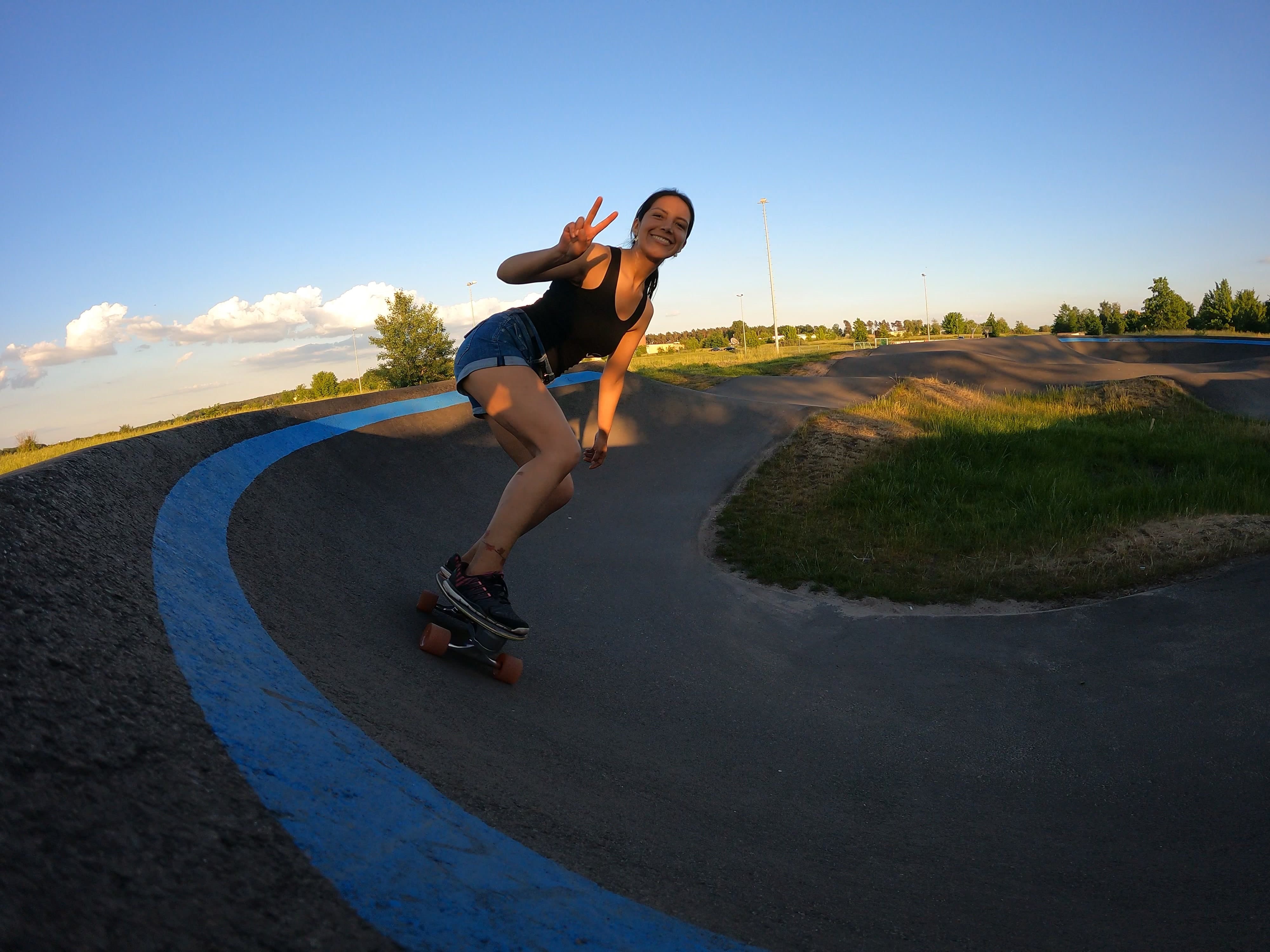
Physics is everywhere in our daily lives—cooking, playing sports, observing nature. We interact with it constantly, though most of the time we’re not aware of it. Now I finally have the chance to write about it and combine it with one of my hobbies: 🏄♀️ surf skating.
I bought my surf skate in November last year. It took me a while to get used to it, but once I did, the movements came naturally. It’s a great way to exercise and challenge yourself, so I definitely recommend it!
The Physics Basics: Friction and Momentum
Let’s get nerdy! There’s fascinating physics at work right from the start. Friction is crucial when you take your foot off the board and push off the ground toward the back—this force propels you forward.
Surf skating is a bit different from traditional skateboarding because you don’t need to push yourself constantly. Instead, you can pump to keep moving. The key is understanding that wheels only roll in one direction. By angling them slightly to the side, you can lean against them and push off to slowly gain more and more momentum, as shown in the video below.
Taking It to the Next Level: The Pump Track
I went to a pump track, and after checking my photos, I was amazed by the positions I was able to hold—positions where I should have been falling!
While trying to answer this question, I did some research and discovered that two main physics principles are at play: conservation of energy and angular momentum. Let’s explore each one and see how they work together to keep me upright and moving.

Conservation of Energy
Energy = Kinetic Energy + Potential Energy
Energy can never be created or destroyed—it’s always conserved. However, it can be transformed. In the case of pump track skating, this means you’re constantly transforming kinetic energy into potential energy and vice versa.
Let me break down these two types of energy:
- Potential energy: Stored energy that depends on your position. The higher you are, the more potential energy you have.
- Kinetic energy: The energy of motion. The faster you’re moving, the more kinetic energy you have.
Here’s how it works on the pump track:
At the top of a pump, you have maximum potential energy (you’re high up) but zero kinetic energy (you’re momentarily at rest). Your total energy is all potential.
As you roll down, you lose potential energy and gain kinetic energy. You feel this as increasing speed. At the bottom, you’ve converted all that potential energy into kinetic energy—you’re moving fast but you’re at the lowest point.
This kinetic energy is what carries you up the next pump, where the process reverses: kinetic energy converts back into potential energy as you gain height and lose speed.
Why You Eventually Slow Down: Friction
If energy is conserved, why can’t I go up and down forever? The answer is friction.
Some energy is constantly lost to friction between the wheels and the ground. Each time you complete a cycle, you have slightly less total energy than before. This means you gain less potential energy on each successive pump and can’t climb as high.
This is why, at the beginning, I wasn’t able to complete the circuit and got stuck in the middle of a pump! I didn’t have enough energy to overcome the friction losses. The solution? That’s where the next principle comes in.
Angular Momentum: The Secret to Gaining Speed
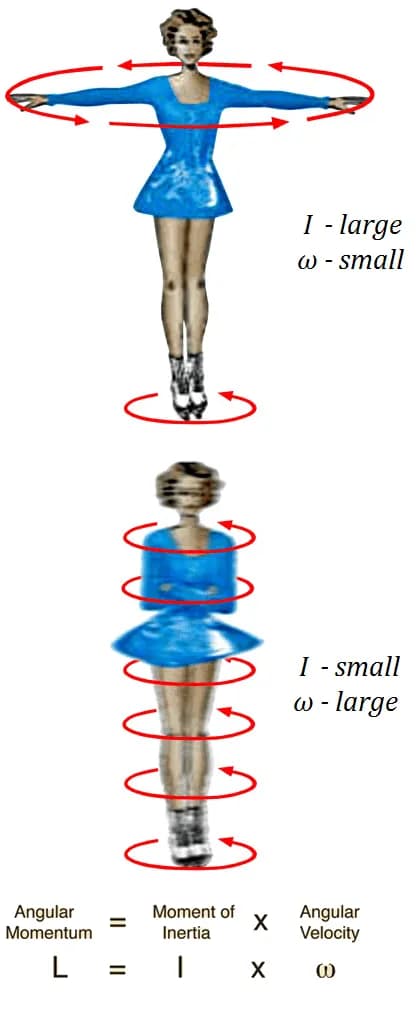
Angular momentum is the quantity of rotation of a body, calculated as (moment of inertia) × (angular velocity). I know that sounds intimidating, but let me explain with a familiar example.
Think about ice skaters spinning. They start spinning with their arms extended out to their sides. When they pull their arms in close to their body, they spin much faster. When they extend their arms back out, they slow down again. This happens because angular momentum must be conserved.
Here’s the key insight: If the moment of inertia increases, the angular velocity must decrease to compensate, and vice versa.
But what is moment of inertia? It’s a measure of how a body’s mass is distributed relative to its rotation axis. The farther your mass is from the axis of rotation, the greater your moment of inertia.
Back to our ice skater: when they spin with arms extended, they have a large moment of inertia. When they pull their arms in, they decrease their moment of inertia. Since angular momentum must stay constant, their angular velocity (spin rate) increases to compensate. The work they do to pull in their arms converts into rotational kinetic energy, making them spin faster.
You can see this beautifully demonstrated in this video.
Applying Angular Momentum to the Pump Track
Now here’s where it gets really cool. This same principle helps me gain speed on the pump track!
Look at the diagram below. As I approach a pump, I crouch down low. This moves my center of mass (the red dot) farther away from the rotation axis (r1), which increases my moment of inertia.
Then, as I’m going up the pump, I extend my body as far as I can, shooting my hands up in the air. This moves my center of mass up and closer to the rotation axis (r2), which decreases my moment of inertia.
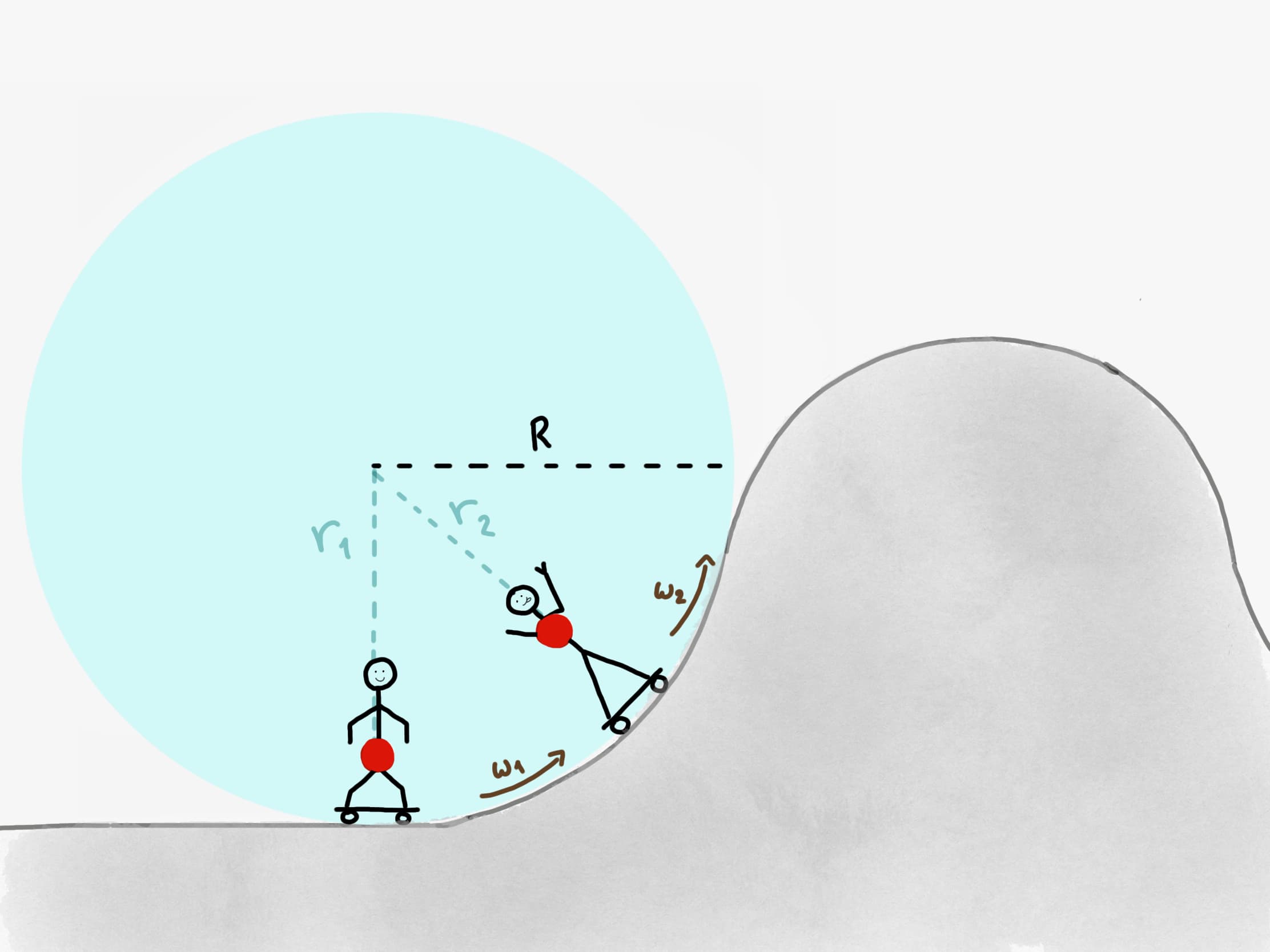


Remember: angular momentum must be conserved. When my moment of inertia decreases (by extending my body), my angular velocity must increase to compensate. The result? I have more speed as I hit the top of the pump than I would otherwise. I could potentially fly into the air and do some cool tricks at this point… but I’m scared!
So to sum up: I can increase my speed by crouching down at the bottom of a pump (increasing moment of inertia) and then extending my body as I go up (decreasing moment of inertia). In the skating world, this technique is known as pumping.
Maintaining and Increasing Speed
By repeatedly pumping—crouching at the bottom and extending at the top—I can continuously increase my velocity. As long as the energy I add through pumping is greater than the energy lost to friction, I can maintain or even increase my speed throughout the track. This is what allows me to complete the full circuit!
The Role of Work
There’s one more piece to this puzzle: work. In physics, work is the amount of energy transferred when an object is moved over a distance by an external force.
When I lift my arms and body up during the pump, I feel resistance due to centripetal acceleration—the force trying to push my body away from the center of rotation. Fighting against this resistance requires effort, which means work is being done. This work adds energy to the system, helping me overcome friction losses and maintain speed.
This is the key to understanding pumping: I’m actively adding energy to the system through the work I do with my body movements, which allows me to sustain or increase my speed despite friction.
Wrapping Up
That was quite a journey through the physics of surf skating! These principles—conservation of energy, angular momentum, friction, and work—all combine to explain why I don’t fall off my board in seemingly impossible positions and how I can maintain speed without ever pushing off the ground.
I can’t wait to go to the pump track again and apply everything I learned while writing this article. Understanding the physics makes the experience even more rewarding!
If you want to explore these concepts further, here’s a cool interactive website where you can simulate a skater’s journey and watch how energy and speed change over time.
Read more